
Peptide-Driven Prep for Greenland
How I’m Shedding Fat Without Losing Muscle for a Thirty-Day Arctic Drag

Before we get into this: I’m not a medical doctor. I hold a BA Honours in Psychology, certifications in exercise science and anatomy, and a personal training diploma. I competed in gymnastics at international level for South Africa and in CrossFit at regional level. I’ve spent over twenty years leading expeditions in polar and extreme environments. I know my body. I’ve tracked how it responds to load, altitude, cold, calorie surplus and calorie deficit for most of my adult life, and I adjust in real time based on what the numbers tell me, not what a forum post suggests. Everything below is my personal research, my protocol, my data. If any of it interests you I’m happy to share my experience, but go talk to someone with a medical licence before you touch a needle or peptide pen.
I’m taking this prep seriously. Nutrition, hydration, heart rate zones, sleep, strength metrics. All tracked. All reviewed. All adjusted when something moves. I’ve done my own research into the science behind what I’m putting into my body and why, and this is my attempt at sharing what I’ve learned. Not as a prescription. Just as one person’s honest account of what’s working, what might be working, and what I’m still figuring out. If you’re curious about what a real peptide protocol looks like beyond the Instagram hype, this is it.
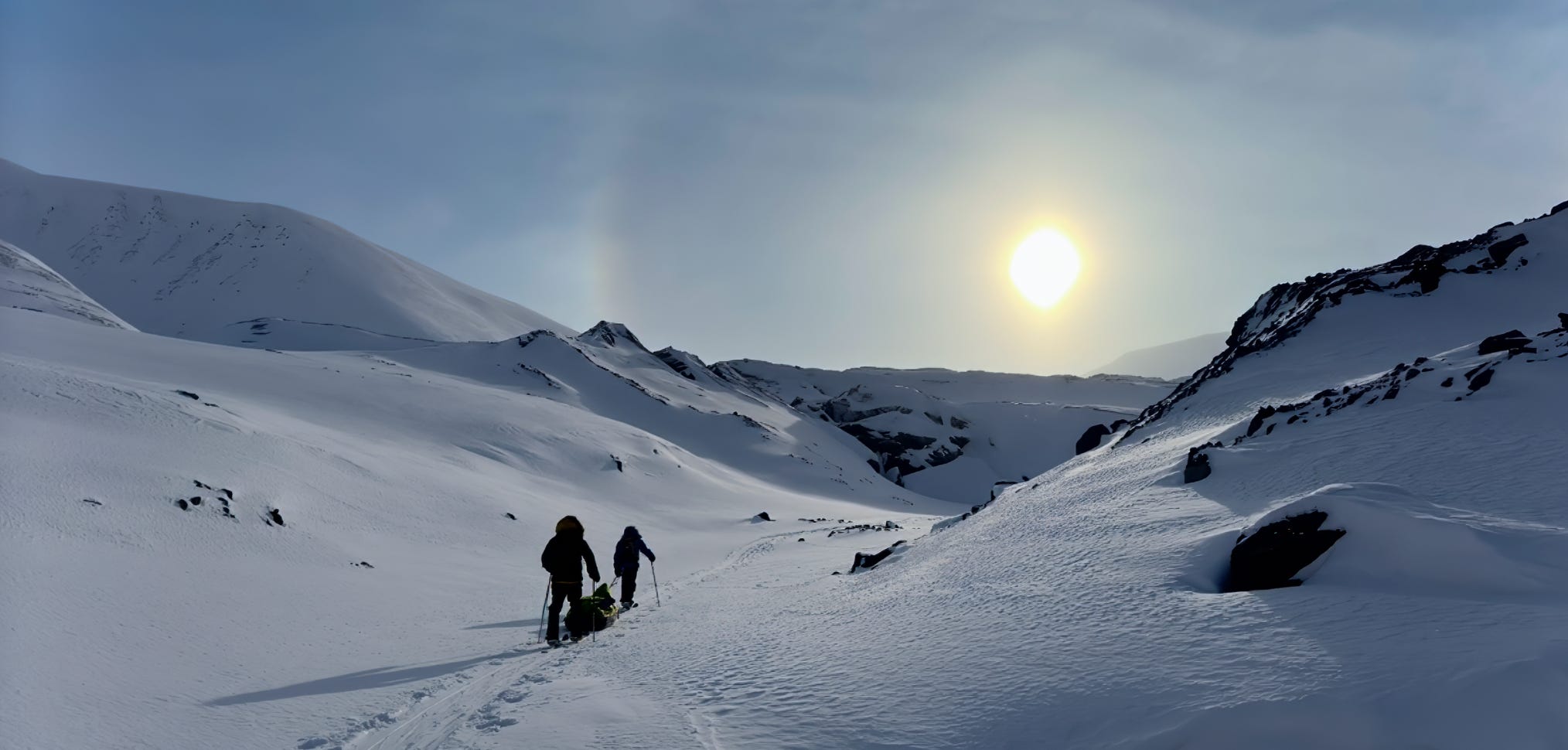
In less than three months I’ll be hauling a hundred-and-fifty-kilogram sled across the Greenland ice cap for thirty straight days. Right now, though, my biggest challenge isn’t the cold or the distance. It’s figuring out what to eat when retatrutide has turned every hunger signal into background noise.
The fat had to go. Years of lodge life and guiding will do a number on your body. Long days, irregular meals, too much sitting in vehicles between walks, client dinners, staff meals, repeat. You accumulate weight slowly and then one day you look down and realise you’re carrying kilos that serve no purpose on an ice cap. Dead weight on a sled crossing isn’t just uncomfortable. It’s dangerous. I’m already dragging a hundred and fifty kilos. I don’t need to be dragging my own fat on top of that. So the goal was simple: strip the unnecessary body fat, keep every gram of muscle, and arrive in Greenland as lean and strong as possible but, and it’s important, enough body fat for the actual crossing!
The protocol
Monday mornings: four milligrams of retatrutide, subcutaneous injection. Thursday: two-milligram booster. Appetite drops within hours. I’ve lost seven to eight kilos of fat so far, and my squat, deadlift and tire-drag numbers haven’t budged. The strength holding is what I’m paying attention to. Not the scale.
Muscle preservation is the whole game here. When you’ve spent decades under a barbell and know what your body does under load, you notice fast when something shifts. A kilo off a deadlift, a rep lost on a squat set, a slower tire-drag split. I track all of it, and I adjust the protocol week to week based on what the numbers are doing. To stop muscle from disappearing along with the fat, I run growth-hormone peptides in the evenings. CJC-1295 paired with ipamorelin, five days on, two off. The combo / stack is called GHX.
Why ipamorelin specifically? It’s one of the cleanest GH secretagogues out there. The original pharmacology work (Raun et al., 1998, European Journal of Endocrinology) showed it fires growth hormone without spiking cortisol or prolactin. That’s unusual. Older compounds like GHRP-2 and GHRP-6 drag those stress hormones up with them. Ipamorelin doesn’t. CJC-1295 sits alongside it and stretches out the GH pulse, so the body gets a longer window to use the signal.
First week on GHX the scale jumped one-point-eight kilos. I expected that. GH peptides pull water into muscle cells, creatine does the same thing. By day 5 it was sliding down again. If you don’t know that water shift is coming, you’ll think the protocol’s failed and bail. It hasn’t. Wait.
Mornings I add a premix peptide pen called “Shredded.” That’s tesamorelin for an additional GH kick, AOD-9604, and MOTS-c, Monday through Friday.
Honest moment on AOD-9604: it’s a fragment of human growth hormone (amino acids 176-191), developed in Australia as an obesity drug. Looked great in animal models. Stimulated fat breakdown without touching blood sugar or IGF-1 levels. Then the biggest human trial came along. Five hundred and thirty-six subjects, twenty-four weeks, and it couldn’t beat placebo for weight loss. Development was killed in 2007. So why do I still use it? Six human trials showed it’s safe, and in the context of everything else I’m running, any extra lipolytic nudge is worth having. Could be doing something. Could be doing nothing. I’m honest about that.
MOTS-c is the one that genuinely excites me. It’s encoded by mitochondrial DNA, not nuclear DNA, which is rare. A 2021 study in Nature Communications (Reynolds et al.) showed it boosted physical performance in mice across all age groups, and in humans, hard exercise increases MOTS-c levels in muscle and blood. The pathway runs through AMPK, which is central to how the body handles energy and burns fat. Human application data is thin. I know that. But the preclinical work is good enough that I’m happy to test it on myself and track what happens. So far, looking good!
Ten grams of creatine in my first protein shake. Magnesium glycinate before bed.
Evening recovery stack
BPC-157 and TB-500 every night for tendons and connective tissue. GHK-copper for skin and joint collagen. Daily doses that let me ruck twenty kilometres per day without feeling like my Achilles is made of old rope.
BPC-157 has been studied in thirty-six preclinical papers between 1993 and 2024. Animal data is strong across muscle, tendon, ligament and bone injury models. Human data? Almost nothing. One small study: twelve patients with chronic knee pain got a single intra-articular injection. Seven of them reported relief for over six months. That’s it for humans. Not FDA-approved. Banned by WADA. I use it anyway because after twenty-plus years of polar expeditions and physical abuse, my tendons are the thing most likely to end this Greenland crossing early. That’s my call, not a recommendation.
TB-500 is a synthetic fragment of Thymosin Beta-4. Where BPC-157 seems to works locally at the injection site, TB-500 is more systemic. It supports cell migration and tissue repair across the body. People call the combination the “Wolverine stack.” I didn’t name it. But it’s pretty coo right?
GHK-copper has better human evidence than most of what I’m running. It’s a tripeptide that boosts collagen production. One study found it outperformed both vitamin C cream and retinoic acid for collagen improvement over twelve weeks. Small pimple-like bumps on my upper arms that I’d had for years disappeared after I started using it. Not sure what they were. Could have been heat-related, could have been keratosis pilaris, who knows. They’d been there so long I’d stopped noticing them. Now they’re gone. I’d put that down to the GHK-copper based on what’s known about how it remodels skin, but I can’t prove it wasn’t coincidental.
What the science says (and doesn’t say)
I’ll break it down compound by compound, because lumping them together is lazy and misleading.
Retatrutide has the hardest data behind it. Triple agonist: GLP-1, GIP, and glucagon receptors. Phase 2 results were published in the New England Journal of Medicine. Twelve-milligram dose produced 24.2% weight loss at forty-eight weeks. Eli Lilly is running Phase 3 trials, almost done now. The glucagon component is what separates it from semaglutide and tirzepatide. It pushes the body to oxidise fat rather than store it. This isn’t peptide-forum talk. This is pharma with billions behind it.
Ipamorelin and CJC-1295 sit on reasonable ground. Ipamorelin’s selectivity for GH release without cortisol is well-documented. CJC-1295 has pharmacokinetic data showing it works as a sustained GH secretagogue. During a calorie deficit, GH reduces protein breakdown, which is the mechanism I’m betting on to keep muscle on. Whether that effect is as large in a healthy adult as the peptide clinics suggest is a fair question. What I know is my deadlift hasn’t dropped through eight kilos of fat loss, and that’s the number I trust.
AOD-9604: weak human evidence. I’ve been upfront about that already.
MOTS-c: strong preclinical, near-zero human application data. Watch this space.
BPC-157 and TB-500: strong animal data, almost no human data. I use them for a specific problem (joint and tendon preservation under extreme load) and I accept the uncertainty. But I am feeling amazing!
GHK-copper: actually has decent human studies for skin and wound healing. Probably the best-evidenced compound in my recovery stack.
Now here’s what nobody has data on: stacking all of these together. The idea that you can combine GH peptides with a triple-agonist like retatrutide and get both fat loss and muscle preservation pulling in the same direction is my hypothesis. I believe the logic is sound. I can point to the mechanisms. But there’s no published trial on this combination. I’m running the experiment on myself, and the data so far looks good. That’s all I can say.
Practical stuff
Drink water. More than you think. GH peptides and creatine both pull fluid into muscle cells. Skip a litre and cramps will find you during tire drags. Guaranteed.
Electrolytes stay high, especially sodium. When you taper off retatrutide your kidneys stop dumping salt, and if you don’t adjust you’ll feel wrecked.
Appetite hack: go liquid. Two double-protein shakes a day, fifty grams each, plus biltong or ground beef between meals. Don’t skip the fats. A spoon of almond butter, half an avocado. Testosterone needs dietary fat. Joints need dietary fat. When appetite is crushed it’s easy to just eat less across the board and that’s the wrong move. Eat less volume, keep the macros right.
How I actually feel
I feel fucking amazing. Energy is up. Training is strong. Recovery between sessions is faster than it’s been in years. Mood is good. Focus is sharp. Whatever this stack is doing under the hood, my subjective experience lines up with the numbers.
And I check the numbers properly. Regular bloodwork. Liver function, kidney markers, lipid panel, fasting glucose, hormone levels. If something was off internally I’d know about it and I’d change the protocol that week. Feeling good means nothing if your bloods tell a different story. Mine don’t. Everything is where it should be. My resting heart rate normally sits around 50. Right now, on this protocol, it’s closer to 60. That’s the GH peptides and Reta at work. I know why it’s elevated, I’m watching it, and I’m fine with it.
One thing that did throw me: my Oura ring sleep stats look rough. Readiness scores dipping, sleep scores inconsistent, and if you just glanced at the app you’d think I was overtraining or getting sick. I’m not. Here’s what’s happening. I take the GH peptides (CJC-1295 and ipamorelin) in the evening. Growth hormone release spikes during sleep, which raises nocturnal heart rate. When your resting heart rate is elevated overnight, HRV drops. Oura uses both of those metrics to calculate your readiness and sleep quality scores. So the ring sees a higher heart rate and lower HRV and flags it as poor recovery. But it’s not poor recovery. It’s the GH pulse doing exactly what it’s supposed to do. Once you understand that, the numbers make sense and you stop chasing a readiness score that’s being skewed by the protocol itself. I still track it. I just read it with context.
Taper
March first I drop retatrutide by one milligram a week. By early April I’m clean, appetite back, ready to shovel down six thousand calories a day without feeling sick. That matters. On the ice cap I need those calories and I can’t be fighting my own gut while fighting a headwind.
GHX stays on cycle. MOTS-c goes to four days a week - training days - if my power output drops.
Skin bonus
Those upper arm bumps vanishing after years is a small thing, but GHK-copper is the likely reason. It speeds wound healing and rebuilds the skin’s collagen matrix. Not why I take it, but I’ll take it.
What it costs
People always ask. The full protocol runs me roughly R3,300 a month, which is around $180 USD. That covers all the peptides, creatine, magnesium, and bloodwork. It’s not cheap, but it’s not the thousands some clinics charge for less. I source carefully and I don’t pay for branding. Worth noting: outside of this protocol, I take nothing else. No pre-workouts, no fat burners, no test boosters, no stack of twenty supplements. Creatine and magnesium. That’s it. Keeps things clean and means when something changes, I know what changed it.
If you’re thinking about trying this
Get your training and nutrition dialled in first. Peptides won’t fix a bad foundation. If your sleep is a mess, your diet is all over the place, and you haven’t touched a barbell in six months, no compound on earth is going to do the work for you. Sort the basics. Then, if you still want to explore peptides, don’t stack everything at once. Start with one compound. Track what it does for at least a few weeks. Get bloodwork before and after. Then add the next thing. That way, when something changes, you know what caused it. If you throw six compounds at your body on day one, you’re just guessing.
So
Peptides aren’t magic. Some have good science, some are educated guesses, and stacking them together is uncharted territory. What I can tell you is: track everything. Scale, lifts, resting heart rate, how you feel, how you sleep. Track it daily. And when something moves in the wrong direction, change something that same week. Don’t wait. Don’t hope it corrects itself. The data is the coach, and the coach doesn’t lie.
Greenland won’t care about my abs. It’ll care that your quads still fire on day twenty-nine.
G.
I am not a medical doctor. I hold qualifications in psychology, exercise science, anatomy and personal training, and I have decades of experience monitoring my own performance in extreme conditions. Everything above is personal experience and research. None of the peptides described (except retatrutide, which is in clinical trials) are FDA-approved for these uses. Several are banned by WADA. Talk to a doctor before touching any of it.